I am curious if there is or will be some kind of supervision of usage notes whether provided information is correct or wrong. I myself frequently check on usage notes I have written, in case I got something wrong or if I'm simply unsure.
In my experience, very long and elaborate usage notes are a pain to read, so they should be rather done in bullet points or short sentences rather than long prosaic paragraphs. Regarding correct information, users tend to just believe the usage notes they encounter and vote them up. Verifying information requires some extra research outside of renshuu, which most people (including me) rarily do.
Usage notes aren't top priority and they shouldn't be, but they are very helpful to explain ambiguous words with different meanings and hence pretty valuable in my opinion. So I would find it useful to either
- have a feature or setup allowing quality control and supervision (by trusted and knowledgeable users?). This is the more sophisticated and costly way.
- have a short guide on writing usage notes with their respective designations "meaning", "how to use", "mnemonic" and "other". This is the more economic and efficient way.
Is this in addition to the existing verification? Public usage notes have to get approved before they're visible to everyone.
When a note has zero likes, that typically means it hasn't been approved. If it stays at zero for more than a few weeks, it has most likely been rejected.
I have wondered the same thing about the sentences in sentence dictionary. I still need a lot of help to write, so i try to use existing sentences as a guide. But i don't know which are grammatically correct and which are not.
i know sentences can get starred. But I can star them myself, and I am a complete beginner. So I am not sure how much to trust the starred sentences.
Robinsparrow1 (11月2日, 0:04)
I have wondered the same thing about the sentences in sentence dictionary. I still need a lot of help to write, so i try to use existing sentences as a guide. But i don't know which are grammatically correct and which are not.
i know sentences can get starred. But I can star them myself, and I am a complete beginner. So I am not sure how much to trust the starred sentences.
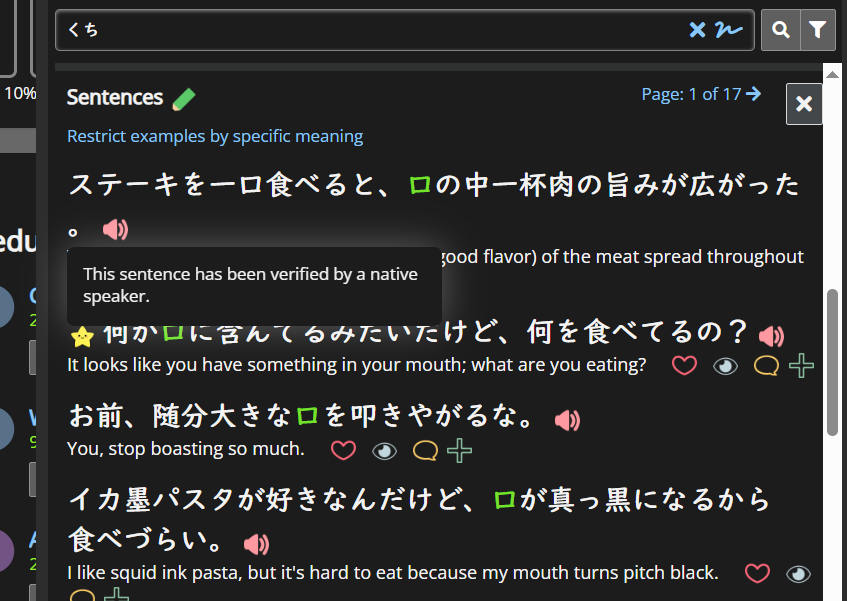
Are you talking about the example sentences you get for vocab? Including anything in the "Sentences" tab of the dictionary.
None of those are written by users, and the star just means there's been additional verification by a native. I occasionally come across some weird translations and incorrect dictionary links, but I can't remember encountering anything blatantly ungrammatical.
These should all be written by native speakers. You can write your own, but they aren't public.
Or are you talking about something else? That's the only "star" I could think of.
ah! Thank you for telling me. I assumed that if enough people heart/like a sentence, they wouĺd eventually get a star.
1. The verification for the usage notes is not a full accuracy check. We're a free platform - that is simply far and beyond what we're able to do.
2. The verification for notes is a simpler check to make sure it is not spam, nsfw, or *obviously* wrong (I realize there is a lot interpretation that could go in here). For vocab/kanji notes, they are not visible until they are verified. For sentence notes, given that it is more of a back and forth, they are visible.
3. User-made sentences are *never* visible in the sentence library. They were all written by native speakers at some point (the majority come from a much older collection called the Tanaka Corpus, but 20-30 thousand of them were written specifically for renshuu. On top of that, we have a native speaker going through the Tanaka ones and making changes for accuracy, correctness, clarification, etc.) That does not mean there are not mistakes, though, or possibly parsing issues (bound to the wrong word in the dictionary, causing the kanji to be wrong, etc.). We fix those as they come up.
Oh, I didn't know there was verification on usage notes. I do rarily see some usage notes that I think can be misleading or written more reader-friendly. That's why I also check and improve my own notes occasionally (despite being approved apparently).