和英辞典Vocabulary dictionary

漢字辞典 Kanji dictionary

文法辞典 Grammar dictionary

例文検索 Sentence lookup

test
 

掲示板 Forums - some unimportant thoughts

Top > renshuu.org > Feature Requests/Improvements


avatar
Chabaka
Level: 21

i really like how much care in the good lessons has been put in, but if you ever get bored. Maybe make more literal translation optional. If the japanese text is dont type messages during classes, why translate it with sending ?? maybe we could choose been literal and another translation.


its absolutely minor giving how much care has been given to the lesson, but i find it unnecessarily complicating things. And while it does not need fixing, i encountered it in so many textbooks, people dont seem to realize its confusing, so i just wanted to mention it


edit: ofc most lessons already have a very good literal translation, but sometimes...

0
9 days ago
avatar
むじな
Level: 893

Hello! If you see a translation that seems confusing in a quiz, right after you answer you can comment on the question and ask about why it got translated like that, or whether it shouldn't be translated differently. You might even find people have commented on it already.

That said, maybe it's worth thinking a little of why the translation is there in the first place. If you rely on the translation to find the answer, something somewhere is wrong – maybe the corresponding vocab schedule should be finished first, or the explanation of that grammar point needs to be re-read. Translations are there just to give an idea of the sentence's meaning if we have doubts.

Also, drawing parallels between words works a little at the very beginning, but as soon as you get past the basics, it's actually harmful to your learning. In my native language, "texting" is something like "the writing of messages" (not even "typing" and not even "texts"). But if I was a native English speaker learning that language now, as soon as I got past "X means to write and Y means message", what I'd need would be for my mind to immediately associate the concept of "texting" with that sequence of three words, not to create a non-existent expression in English and learn to bind those words to it.

Bottom line: apart from the immense effort of going through all translated sentences in Renshuu and providing alternative literal translations (which would usually be "broken" in English), that would risk creating bad habits in language learning.

4
8 days ago
avatar
Chabaka
Level: 21

It was during grammar lesson, but i have not thought how they would say it in other countries. i use the grammar too to learn grammar and vocabulary.

Anyhow the work done on this site is marvelous and i sometimes overexagerate tiny points.

i started learning ith textbooks were they translated hajimemashite with hello.

1
8 days ago
avatar
むじな
Level: 893

Congrats, then you're on the right path! Just curious, since you gave that example – how did you feel about being introduced to "hajimemashite" as "hello"? Because it could be a good example for the utility (or lack thereof) of literal translations.

Of course, something like "nice to meet you" might be closer to the idea, but we can't really translate it as "we meet for the first time", or we could, but it wouldn't be actual English, since no one really says that. Eventually, you would have reached the point of learning that はじめ / 始める / 始まる means "beginning, doing something for the first time". Then you would have made the connection.

But if a native English speaker tries a textbook or app that starts with an introduction and provides a "translation" like "Meeting for the first time. John is. Please show kindness. Japanese pupil is" and so on... I don't think they'd like that textbook/app much. :))

1
7 days ago
avatar
Chabaka
Level: 21

i dont want to subtract from the nice conversion and hope im not unpolite. but 初(はじ)めまして, you are using the one for beginning.

yes but i think if literal translation exist, in general, it would help understanding the logic better and it would reduce mistakes.


1
7 days ago
avatar
むじな
Level: 893

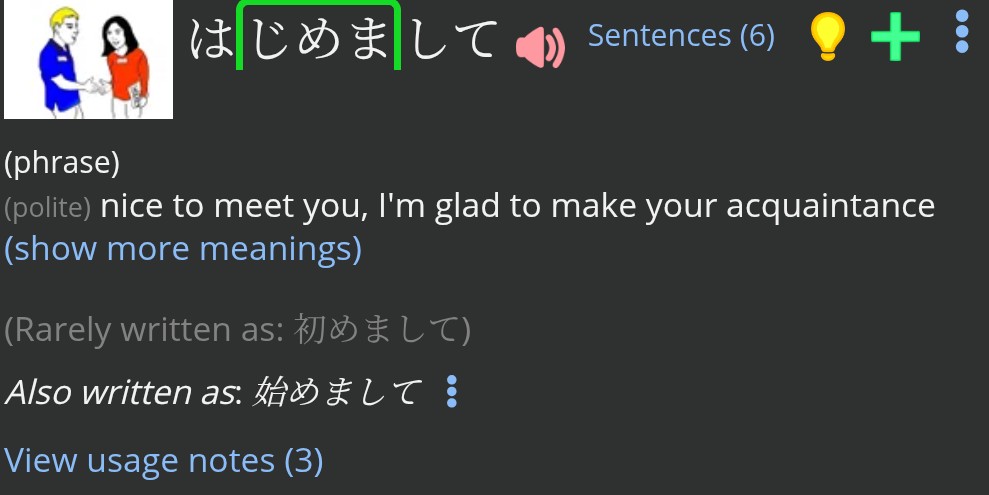
While it's usually written with just kana, 初 and 始 are both used for it. I'm no expert, so I'll just copy what the Renshuu dictionary itself has to say:

bc9a4bfde14b47b2fe350afb.jpg

My argument about literal translation was that, while it's true that it might help people understand very early in their learning journey, later it can cause a lot of misunderstandings. The logic of a language is found in itself, not in creating imaginary parallels (though they, too, can help with memorising). As for reducing mistakes, that would only happen if we relied on the translation to choose the right answer, which might not be a good idea.

Summary: it's my opinion that literal translations, though they look like an ally, would lay a lot of traps in the learning process and provide "crutches" that deform our view, but every learner's experience is different and some may find them useful early on.

2
7 days ago
avatar
むじな (09月19日, 14:29)

While it's usually written with just kana, 初 and 始 are both used for it. I'm no expert, so I'll just copy what the Renshuu dictionary itself has to say:

From my understanding (plus a few native discussions on the subject), the "correct" modern form is 初めまして. When Renshuu says "Rarely written as: 初めまして" it means this is a rare modern kanji spelling, rather than the more common full-hiragana version.

The older spelling is 始めまして, which some people still use, hence "Also written as" (as opposed to 初めまして). Just keep in mind that some natives may actually flag it as "wrong".


PS: 始まる doesn't really mean "doing something for the first time", it only means "to begin"; "to start"; etc., basically "something is to begin/start" (with 始める being the transitive version). The "for the first time" meaning is usually associated with the 初 kanji instead.


初め て (はじめて) = for the first time

始め に (はじめに) = at the beginning / first / to begin with


You can use either 初 or 始 in a lot of cases, but the nuance, and sometimes even the meaning, changes depending on the kanji. Just something to keep in mind :)

Edit: Oh, and 初める is そめる not はじめる. You didn't make that mistake, but I like pointing it out :D


PPS: To add something to the actual topic: More literal translations can be helpful, but not always. An optional — carefully crafted and very clearly labelled — more literal translation could be useful in a lot of cases, but I suspect the juice is simply not worth the squeeze for Micheal. He seems to always be very busy and rarely ever "bored" :)


Edit: Reading the topic up to now, I feel like we (referring to OP) have a slightly different idea of what "literal" means. To me it's about keeping the structure of the Japanese original relatively unchanged, while also clearly maintaining its meaning and nuance. You're still aiming for natural English. Of course the idea is to convey the meaning/nuance, not to teach you English. Slightly "unnatural" language is thus not an issue, provided it's not too awkward and very clearly conveys the meaning.

Note that this doesn't mean 1:1 literal translations of individual words. Those simply don't work a lot of the time.


If you'd like to learn individual words, you can tap/click on them and look them up in the dictionary. They often have a lot of different meanings/uses, so you simply can't learn them just by looking at a few sentences.

3
6 days ago
avatar
Chabaka
Level: 21

this site doesnt have the problem too much.


but here is what i found somewere else


彼は暇なときに本を読みます。


when he is bored, why not just say when he has spare time?


or sakana yaku

why translate it with cooking instead of grilling??

what is so bad about a literal translation?


1
5 days ago
avatar

"what is so bad about a literal translation?" As I said, literal translations aren't always bad. I don't have an issue with good, clear, and helpful (more) literal translations. It's just difficult to always have them available.


1) 彼は暇なときに本を読みます I would translate as "He reads books in his spare time" or "He reads books in his free time". He may or may not be "bored", so I'd personally avoid it. I think Renshuu does a pretty good job with 暇な時, e.g. 暇な時は本を読んでいる (and the other examples you can see from the dictionary entry).


2) 魚を焼く typically means "to grill/roast fish", basically to cook something with direct/dry heat. Could be under a broiler or a pan (フライパン焼き) with very little oil.


What you're describing here aren't "literal" translations, but rather "good" vs "bad" translations. At least to me. I think "bored" is (almost) a mistranslation, not an issue of how "literal" the translation is being.

Two equally valid translations for the first example would be "He reads books in his free time / spare time" and "He reads books when he has free time", in which case "in his free time / spare time" would be more literal, and arguably preserve に in a way that helps with understanding the grammar.


For 魚を焼く, I wouldn't use "cooking", I think that's too general, and not very helpful given the nuance of 焼く. Once again, I don't view this as an issue of literal vs non-literal, but as good/helpful vs bad/unhelpful.


I think you may have just found some "bad" translations :D


PS: Of course you can't generalise and say that "literal" translations are always better. They are in those specific cases, but not always.

Phrases like よろしくお願いします and お疲れ様です can be translated in a variety of different ways depending on context, translating them literally can actually give an English speaker the wrong idea about what the Japanese speaker is actually trying to convey. Of course this isn't limited to set phrases, it also happens with certain words.


Anyway, I don't like the term "literal", to me there are translations that correctly convey the meaning and nuance of the original Japanese, and those that fail to do so. Doesn't necessarily have to do with how literal they are.

So apart from the terminology, I think we probably agree on what a good translation looks like :)

3
5 days ago
Getting the posts


Top > renshuu.org > Feature Requests/Improvements


Loading the list
Lv.

Sorry, there was an error on renshuu! If it's OK, please describe what you were doing. This will help us fix the issue.

Characters to show:


Use your mouse or finger to write characters in the box.
■ Katakana ■ Hiragana