掲示板 Forums - Kanji (*´Д`*)
Top > 日本語を勉強しましょう / Let's study Japanese! > Anything About Japanese Getting the posts
Top > 日本語を勉強しましょう / Let's study Japanese! > Anything About Japanese
I dont understand that with different speaking like(im not good at english srry) that konyugo(or smth) and that (other thing) which one do i use to pronounce the kanji and for what do i need 2?!
(Im new in kanji ;)
You probably mean kun'yomi and on'yomi.
This may not apply all of the time, but to get started:
Kun'yomi is the Japanese pronunciation of the kanji. For example, they have the word "くるま" for the stand-alone word "car". This word can also be written with the kanji "車" (which also means car), but it's still pronounced "くるま".
On'yomi is the original spelling of the kanji, adapted to Japanese. Where you often see the on'yomi spelling is in compound words. For example, "ambulance" in Japanese is "きゅうきゅうしゃ". The kanji for this word are 救急車. Recognize that last kanji? That's the kanji for car. An ambulance is a sort of car, after all. Now, since it's part of a compound verb, the on'yomi spelling is used and it's pronounced as "しゃ".
Keep learning kanji and words that contain those kanji. The more you learn, the better you'll recognize the differences and exceptions.
( you already got an answer, but I'll throw in mine too, since I was in the middle of writing it and I think it gives you some additional information )
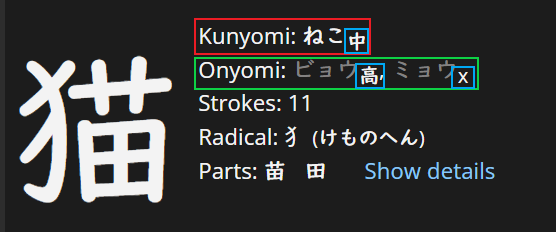
🟥 Kun'yomi are usually native (Japanese) readings, and are typically used when you have a kanji by itself. So the word for "cat" ねこ, would be 猫 (ねこ, kun). This is common for a lot of adjectives and verbs. 速い、 遅い、 寝る、 動く、etc. Basically, when you see hiragana directly after a kanji, and you can tell that it's not grammar, the kanji is usually going to use one of its kun'yomi. That hiragana is called okurigana (送り仮名(おくりがな)), and you can see it in ( ) when you look at the dictionary entry for kanji such as 動. In this case you have うご + (かす) and うご + (く), which would looks like 動かす and 動く in full kanji.
🟩 On'yomi are based on old Chinese readings (Kanji comes from China), and are typically used in words where two (or more) kanji are "stuck" together. So in the case of 猫, you have words like 愛猫/あいびょう, 老猫/ろうびょう, etc., where 猫 is read びょう.
🟦 Shows you the school-grade where readings are taught. They go 小 (primary)、中 (middle)、高 (high)、x (unknown / not taught in school).
Kanji often have more than one kun'yomi/on'yomi, and you pretty much just have to know which one is used in any given word. There are tendencies that can help you make an educated guess, but at the end of the day you learn the words themselves, you don't read the kanji as if they were letters.
For example, you just need to know that a word like 雨水(あまみず) is read using kun'yomi for both of the kanji. Of course readings aren't completely random. The tendencies I mention in 🟥 and 🟩 are quite useful. It's just that there are lots of different readings and a good amount of exceptions.
What I like to do is to learn different readings in the context of words. You still quiz kanji separately, but your main focus is on learning words. For example, when I see 既に, I know how to read it and I know what it means, but quite frankly, I couldn't tell you the exact meaning of the kanji 既, and I'd have to learn some compounds to really memorise its on'yomi. I guess I know in from 既読/きどく, but took me a minute to remember it in isolation :D
Sooo if i understood it right then kun‘yomi is a kanji that has it word alone and on‘yomi is that you can put it in like a word with a following kana and there are many of them?
Wait nahh now i understand nothing, konyomi example: 日 is day/sun and どよう日 is saturday but only kana it would be どようび and the onyomi is ジツ then why do they still use 日 in that word?.
:/
日 has a kunyomi of ひ alongside the onyomi ニチ/ジツ.
In どようび, the last び is ひ that has followed the common sound change known as "rendaku".
In sunday, 日曜日(にち・よう・び) you have both onyomi and kunyomi for 日 in the same word.
Wait nahh now i understand nothing, konyomi example: 日 is day/sun and どよう日 is saturday but only kana it would be どようび and the onyomi is ジツ then why do they still use 日 in that word?.
:/
Two strangers on the internet took the time to write a detailed answer to your question.
Please be so polite to read the answers before asking further questions. That new question of you has been explicitly answered in the earlier answers.
If you see a compound word, and you don't know which reading to use, you can often guess that it's the on'yomi reading.
However, it's true that the kun'yomi reading can also appear in compound words. These are the exceptions we were talking about; something you just have to learn over time. Eventually, you'll get the hang of it.
(I also just want to say that it's completely fine to not understand something after one or two explanations. After all, Japanese isn't the easiest language out there. Don't be afraid to ask questions, stay curious, and keep learning.)
To come back on your question of whether you should practice writing kanji: I would definitely recommend it.
I don't think you'll often have to write something in Japanese by hand. Writing letters is somewhat outdated, and with a Japanese keyboard you only need to type in hiragana and it can automatically convert to kanji.
Should you practice your writing nonetheless? It's not exactly necessary, I'll be honest. However, it can be extremely useful:
1) You'll remember kanji better. Writing something out by hand keeps things better in your mind.
2) You can distinguish between kanji better. When you write out kanji, you'll notice subtle differences better. It can become easier to tell them apart.
3) It's simply fun; especially when you manage to write your kanji better and better, and be able to look back on the progress you've made.