"is there a growing expectation that you should know them? Is it a generational thing maybe?"
No, rather than a "growing expectation", it's a bit different. But before answering that, just a point on how Japanese kanji through school.
Japanese start kanji in primary school and more specifically, they study the 教育漢字 (roughly the first 1000 kanji). And they study the "hardcore" way during that time. They are forced to do 漢字ドリル during all those years for example. Basically, they copy each kanji 20, 40 times (the number are arbitrary here). If they forget even one kanji, they are given extra assignement to write them again. Even for the next day with some teacher. And that just for writing part (there are a bunch of other exercises they often do during those years).
Because of that, they have a pretty good mastery of all of those 教育漢字. But good mastery doesn't mean perfect mastery. Even it will still be like 95% (again random number here). Past primary school, they don't do those 漢字ドリル anymore. They still study kanji in isolation but, from middle school to high school, they increasingly "learn" and "remember" kanji through words/immersion rather than in isolation. They don't really "study" kanji anymore. Another thing that is important is the kanji classification (middle school/high school kanji and readings) is closely tied to their education system. What that mean is that, they are exposed to those kanji, or more exactly words, through math, geography, history, literature, etc., etc.
For example, 建立. The りゅう reading of 立 is important for Japanese history. Because 建立 is mostly used for the act of building temple or things like that during a certain period of time (I don't remember which one). And some Japanese will remember that reading because of that (if they like history for example). But not everyone. It's like expecting everyone to go school to remember everything they learned perfectly. That doesn't happen anywhere in the world. Though, they do recognize quite a lot of them through immersion indirectly. But it depends more heavily on various factors: school subjects, textbooks, entrance-exam preparation, books, manga, game, newpapers, internet, hobbies, occupation, etc.
Because of that, two different adults may have noticeably different productive knowledge of kanji. Some may not as good as others with 常用漢字 (the 2000 so-called everyday kanji) but know a lot of kanji outside the 常用漢字. Because of all of the factor that I listed previously. If they like science but don't like to read a lot, they will know a lot of specific kanji or readings tied to science.
Basically, starting from middle school, kanji start to become more specialized and bit heterogeneous. Some are still quite common but other are quite specialized already. And since, Japanese are not forced to study them in isolation like in primary school, their kanji knowledge start to be dependent (on all those factors that I mentioned previously). That doesn't mean you should understimate the 常用漢字 but you shouldn't overstimate them either. If you like science or you have a scientific, you may need some uncommon kanji or readings sooner if you want to talk about yourself. And inversely, if you don't plan to live in Japan and also don't have any interest history, you may not see 建立 for the rest of your life. As foreigner learning Japanese, you won't necessarily need the exact same kanji knowledge compared to native Japaneses. Hence why, I think it can be quite important to spend enough time on the 教育漢字 and their primary school readings. But past that, it become more variable. Which still doesn't understimate the 常用漢字 kanji. But past those 教育漢字, "learning" and "remember" kanji through immersion is more important and efficient imo. Which can mean remembering only one word for a certain reading without studying its kanji. That can be enough for a foreigner. And also enough for Japanese for some specific kanji and readings.
Okay, that being said, let's move on to your initial question. And no, it's not a "growing expectation". It's kinda of generational thing but since maybe the 80? Thanks to personal computer becomming incredly common and internet?
So rather than a "growing expectation", they already "know" more kanji than before. Well, more they able to "recognize" more kanji.
And "Japanese natives using rare kanji a lot online to sound smarter or something, and because it's become easier with autocomplete", that part was maybe because of me but it's a bit misleading. Especially, the "to sound smarter". If it was me that wrote that, then it was closer a complain than a complete and accurate picture of what happened (doesn't mean it was a lie but there are a lot of other factors). A simple way to see it is just "they are exposed to more kanji" and since they also write less than before, they kinda trade-off their abilities to write for the ability to recognize more kanji. Which doesn't mean they "study" more kanji btw. They simply "learn" and "remember" more kanji through exposure.
If you want a simple comparison, kids often learn words through picture books with their parents pronouncing those words for them and making them repeat those words. Adults kinda do the same things through youtube for example. Even if you know about science, you can easily watch a science-themed channels. And by watching those channels regularly, you will start to associate words with reality (not definition). The same way you may have learn some animal's names with a picture without ever a definition in a dictionary. More complexed or advanced are basically the same. And you may not be able to define each of those but still have a rough, and at the same time oddly accurate, grasp of their meanings.
People know more things than before. Or more exactly, more different things (not necessarily more overall). Simply, because it's more accessible through internet (but TV did the same thing during the last century, and books too a long time ago). Japanese is the same in that regard like any other language in the world. Except that, in Japanese, you have kanji. "Autocompletion" is one important factor for Japanese but not the only one.
Now, what does that mean for you, as a foreigner learning Japanese, well, first don't use the "rare kanji" for every words. Especially for basic words. It will be a bit too much. I never seen まで in kanji for example. That doesn't mean I won't or you won't but the probably are much lower for that kind of words. Extremely common words are not always in their kanji form for probably multiple reasons. Same with extremely uncommon words. Though for everything in-between, that's a different story. Sometimes, yes, sometimes, no.
Instead, I can give 3 reasons to study rare kanji:
- You saw it online
- Just in case because you don't want to relearn those words later
- Because the kanji help you to understand or remember that word
Those are the main reasons why I end up studying rare kanji :D
And the first reason is the most important/common reason. As for the others, it's up to you.
In my case, I often study rare kanji for the 2 others but that's just because I like kanji. I don't mind accidentaly learning "really" uncommon kanji. But if it's not the case for you, the first and last reasons are more importants.
And for more specialized words/kanji, up to you. If you like math, then just learn them, that's all. Especially when you're done with the 教育漢字. Or even before. Because you will need them to talk about you later or when meeting with some Japanese that have the same hobbies, occupations, works, etc. It's never too soon to learn them. Even during you first conversation with natives, you may end up talking about that, so yeah, go for it, if you have the time/energy. And conversely, past the 教育漢字, it may be better to start to focus more heavily on yourself and immersion (like natives). You won't develop the same vocabulary and kanji knowledge compared to natives but you don't need either. At least at first and also depending on your goal. It's easier and faster to focus on yourself because it will allow you to start immersion sooner and even have complex conversation with natives about your hobbies sooner too (and that will boost your overall level faster). For online learner at least. For people that will live, study or work soon, that's a different story. Oh and btw, that's mean wait until you're done with the 教育漢字 too. You can start sooner if you want and have the time/energy. It can better in terms of motivation too and allow you start immersion sooner.
Okay, I wrote too much again. I'm done 
Hope that helps!
頑張ってね~

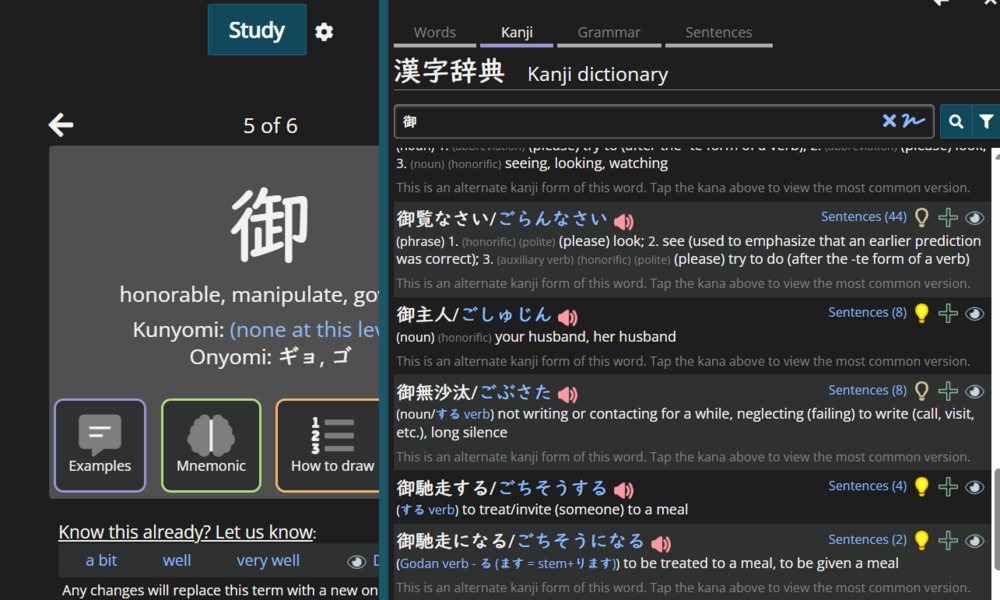
 So, I've seen a post recently in the forum about Japanese natives using rare kanji a lot online to sound smarter or something, and because it's become easier with autocomplete. I since enabled the "use rare kanji" in Renshuu and wow... there are a tonne of them


 .
. "
"