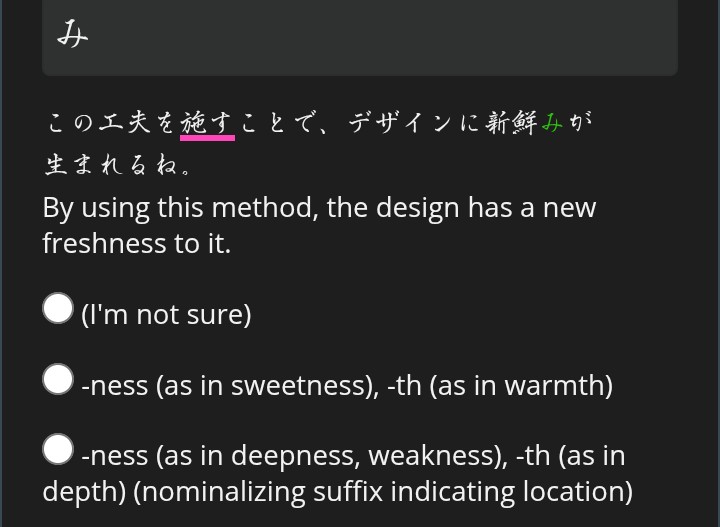
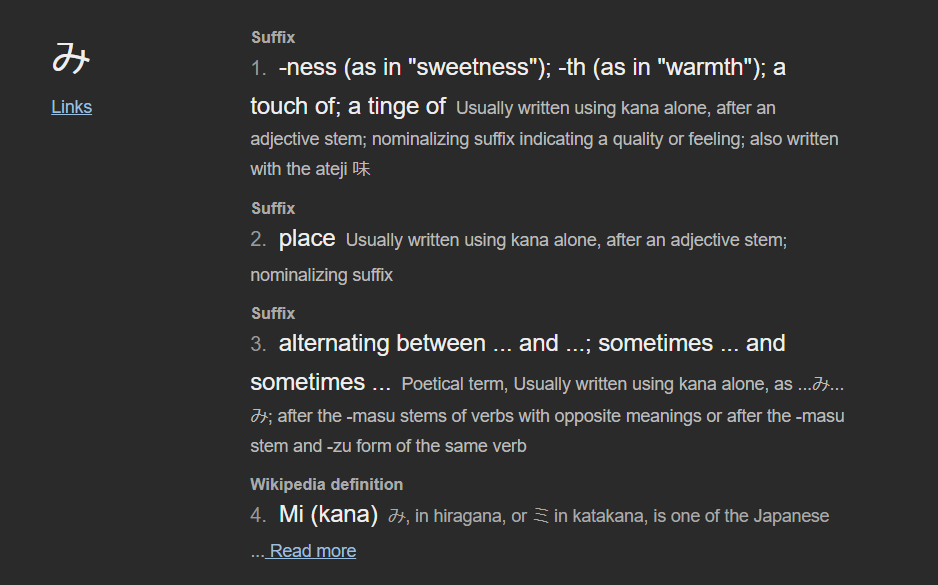
Thanks for the clarification (although it's still rather unclear to me). The way it is split here on renshuu is very confusing.
On a tangent, I've always understood み as an "emotional" nominalizer and さ as a more "objective" one. So 深み = depth (e.g. in the meaning of a poem or the character of a person) 深さ = physical, measurable depth. So I don't fully grasp how 高み etc. pertain to "location".
I've always understood み as an "emotional" nominalizer and さ as a more "objective" one.
That works in a lot of case, but is an oversimplification that breaks down quite easily. 甘み is simply the "sweetness" of food, nothing "emotional" about it. 甘さ is similar, but the difference is that 甘み is the general concept of "sweetness", while 甘さ is the "degree" of sweetness.
How does 高み pertain to "location"? That's actually its original meaning, "a high place". A "high place" IS a physical location. 高み in something like 高みの見物 very much refers to a physical place, even though the expression is usually metaphorical.
And then 高さ is basically the degree/amount of being "high" or "tall".
「痛み」: 痛むこと、痛んでいる状態にあること = Pain, in a state of pain 「痛さ」: どれだけ痛んでいるかの状態・程度 = A state indicating how much pain, an amount
So 痛み refers to the phenomenon itself, while 痛さ treats "painful" as a scale. Does that make sense?
PS: I think the "emotional vs objective" distinction is more of a byproduct. Many ~み nouns are also used metaphorically, so they can feel more subjective, but that comes from the base adjective and the nuance of ~み, not from ~み itself being "emotional".
Something like a 丸みショートボブ (hairstyle) is far from anything "emotional" or "subjective", or a feeling at all. It's just a quality/aspect that something possesses.
Note that the secondary meaning of 丸み is a metaphorical extension built on top of the literal one.