掲示板 Forums - I need help on a question
Top > 日本語を勉強しましょう / Let's study Japanese! > Anything About Japanese Getting the posts
Top > 日本語を勉強しましょう / Let's study Japanese! > Anything About Japanese
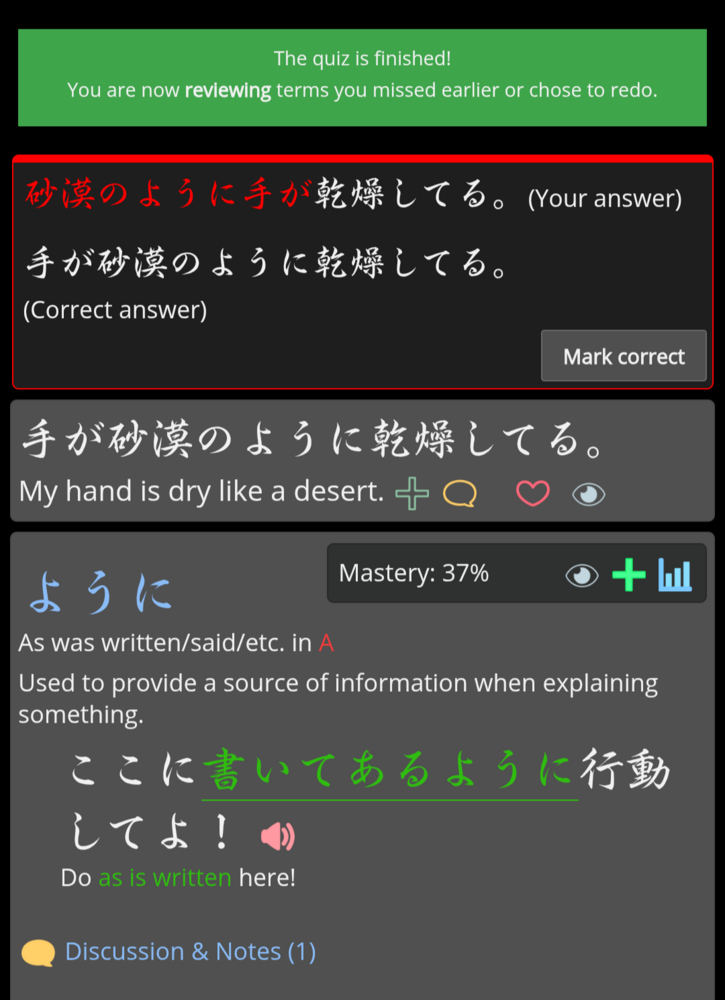
砂漠のように手 is grammatically wrong as it would have to be のような and not のように. Now 砂漠のような手 means something like "a desert-like hand".
You have to be careful about what is bound to a subject or object (i.e. a noun). In this case, everything before が is bound to the subject 手. Hence, the meaning changes completely.
That's because you process "砂漠のように手" as a single block. Even if it's before 手が, it won't be interpreted as modifying the subject, because of に, and everything won't be interpreted as the subject. But with な, that would be the case and it would change the meaning.
So, it's not wrong grammatically. Just maybe a bit uncommon because it kinda give some dramatic effect.
It effectively parses as 砂漠のように、手が乾燥してる, so there's no grammatical issue with 砂漠のように手 appearing in sequence. It just feels a bit more dramatic or literary, which can make it sound awkward in casual speech. Honestly, the register mismatch is strong enough that I actually don't mind it being flagged as "wrong".
Fronted adverbial phrases like ~のように are actually quite common in literary writing. They modify the entire following predicate rather than the nearest noun. For example (and there are plenty like this):
夢のように時間が早く過ぎていく = 夢のように + 時間が早く過ぎていく, not 夢のように時間 + が早く過ぎていく.Yeah but register perception is a thing that takes years and a lot of immersion.
At least the grammar/order is correct. Good enough for now, it's fine to take it as is.
If the question was about register as well, sure. But it's not and you're left with a "you're wrong".
That why I don't like grammar question in app x). Especially as self-learner (If you have someone to guide you tho, it's just completely different).
Also, just in case someone misunderstand, it may sound awkard if misused in casual speech but that doesn't mean, it's not used or not common. It can be quite common with people that like to play with that kind of speech, especially amongst friend. With strangers on the other hand, that would definitly feel akward most of the time.
Yeah but register perception is a thing that takes years and a lot of immersion.
At least the grammar/order is correct. Good enough for now, it's fine to take it as is.
If the question was about register as well, sure. But it's not and you're left with a "you're wrong".
That why I don't like grammar question in app x). Especially as self-learner (If you have someone to guide you tho, it's just completely different).
Also, just in case someone misunderstand, it may sound awkard if misused in casual speech but that doesn't mean, it's not used or not common. It can be quite common with people that like to play with that kind of speech, especially amongst friend. With strangers on the other hand, that would definitly feel akward most of the time.
Do you think I should report the question saying my current answer should also be valid or should I leave it like that?
Yeah but register perception is a thing that takes years and a lot of immersion.
At least the grammar/order is correct. Good enough for now, it's fine to take it as is.
If the question was about register as well, sure. But it's not and you're left with a "you're wrong".
That why I don't like grammar question in app x). Especially as self-learner (If you have someone to guide you tho, it's just completely different).
Also, just in case someone misunderstand, it may sound awkard if misused in casual speech but that doesn't mean, it's not used or not common. It can be quite common with people that like to play with that kind of speech, especially amongst friend. With strangers on the other hand, that would definitly feel akward most of the time.
Do you think I should report the question saying my current answer should also be valid or should I leave it like that?
Up to you x)
I don't why マイコー decided that only this variation is correct. I'm not even sure that he even thought about it.
It could be for technical reason like not having the time or money to create perfect questions with every possible answers. In that case, maybe he will agree.
Or maybe, it's for pedagogical reasons and it's deliberate. Like not wanting you to learn less common speech before you mastered the most common and neutral speech.
So I don't know. Well, you can report if it really bother you. And マイコー will just say yes or no. At worst, it would be some feedback on the question.
The system does not have a list of all possible variations - it uses a set of rules to determine if other orderings are grammatically correct, and then has additional per-sentence markings when needed.
As to this one, while it would be nice to let the system swap those two out, from a flow perspective, I don't feel like it's quite as natural.
By moving that all to the front, you're separating the adverbial phrase (all that stuff that ends with the に) from the thing you're modifying - the verb. The way it is ordered in your answer puts the phrase next to the noun, and that's a mismatched modifier.
I don't see how separating the adverbial phrase from the verb is an issue. You can find dozens of examples on Renshuu itself that do exactly that. Am I missing something?
That's fair. I think we're mostly in agreement. I was never arguing that [subject が adverb-phrase verb-phrase] and [adverb-phrase subject が verb-phrase] are interchangeable, or that the latter is always equally natural.
My point is simply that the second pattern is a valid construction that can sound perfectly natural in the right context. Whether it does depends on the style, register, and effect the writer is aiming for.
To me, it's a fairly ordinary literary/narrative construction, though it just doesn't quite work in this specific example :)
Here's a better set of Renshuu example sentences, (hopefully) showing that an intervening [subject が] between an adverbial phrase and a verb phrase isn't inherently a problem:
あの夜のように、三日月が出ていた。→ [のように] + [三日月が]
このアニメのように、魔法が使ってみたいんだ! → [のように] + [魔法が]
私の父はビリヤードの玉のように頭がつるつるだ 。→ [のように] + [頭が]
ザーッと滝のように雨が降って来た 。→ [のように] + [雨が]
砂漠のように手が乾燥してる。→ [のように] + [手が] (our sentence)
And then, something like 砂漠のように、手が乾燥していた feels much less jarring to me, because it better matches how this structure is typically used in narrative contexts. Not a direct alternative, just an example.
A TLDR of my argument:
Is the structure grammatical? → YES
Is the structure common/possible? → YES
Does this specific sentence sound natural? → NO
PS: Just as a side note, the interesting part for me is the language discussion itself, not really whether the parser should or shouldn't accept it. I'd still probably say it shouldn't be accepted in this case.
By the way, feel free to ignore me, I don't want to take up too much of your time :D