Vocabulary dictionary

Kanji dictionary

Grammar dictionary

Sentence lookup

test
 

Forums - What is the point of Kanji?

Top > 日本語を勉強しましょう / Let's study Japanese! > Anything About Japanese


avatar
Disir
Level: 49

Hello, all! So, I've recently started studying Katakana after learning Hiragana, and those two make sense. One handles characters/letters native to Japanese people, and one handles "borrowed" words. That's fine. I can work with that.

But why on earth do I have to basically learn Chinese while studying Japanese. Can someone explain this nonsense? Thanks.


I don't mean to annoy people with my complaints. I apologize if it came off that way.

2
3 days ago
avatar
463_2021111612400207c.png
31
3 days ago
avatar
Shamugan
Level: 741

Basically, it's what allow you to learn and differentiate words. Just type かえる in the dictionary and you will end up with a lot of words already. Without kanji, while reading, it's hard to distinguish them.
When you mastered enough kanji, you will also learn words way faster too. Kanji are like some kind of single concept or image and once you're more or less used to that image, words are just "combination" of kanji.

液化 -> (liquide) + (transformation) -> transformation into a liquid -> liquefaction

You can even understand the meaning of difficult scientific words thank to that. Like if I say "microtia", except if you already know that word, you probably can't understand what that word is about. But with kanji, you can guess more or less the meaning of those kind of words.

小耳症 -> (small) + (ear) + (symptoms, disease, ilness) -> Small ear condition (microtia is a condition where the auricle, external part of the ear, is underdeveloped)

So while kanji can seems daunting, they become very useful later for that.
Also, unless you want to focus exclusively on speaking and have only limited ability to speak about various subjects, you just need them =p


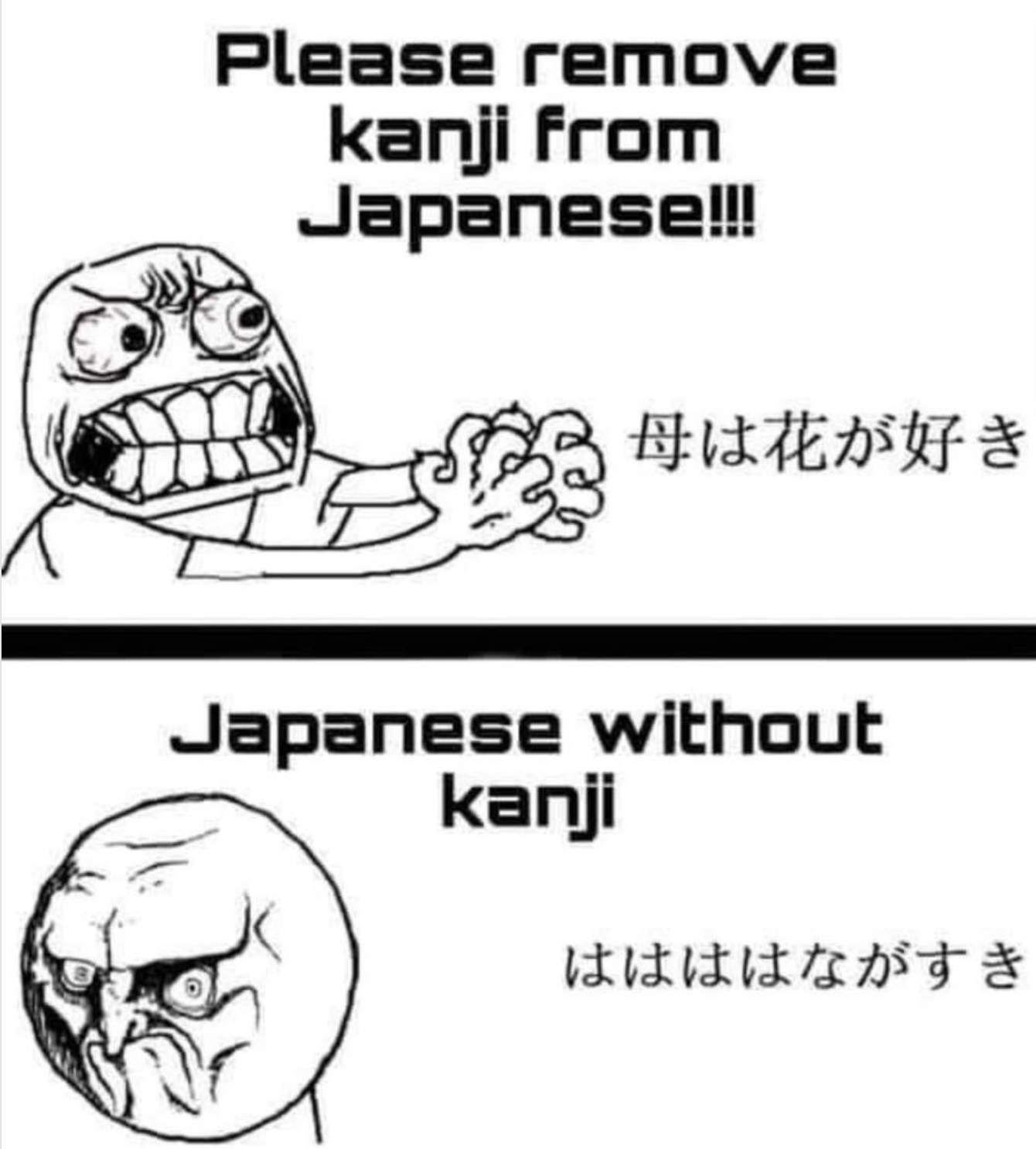
PS: the meme from ポールおじちゃん kinda summarize the first point. Most beginner kinda don't like kanji. But for those push through until intermediate level, they often end up loving kanji =p.

10
3 days ago
avatar
むじな
Level: 724
Disir (0330, 20:52)

I've recently started studying Katakana after learning Hiragana, and those two make sense.

​First: congratulations! There are people who start all fired up, then throw up their hands and quit before going through all the hiragana. You got this.

Second: kanji do make sense. With absolutely zero intention to sound patronising (and many apologies if I do), the more Japanese you learn, the more "a-ha!" moments you have and the more you realise they're a huge part of how the language works. ポールおじちゃん's example says it better than a thousand words* (and made me laugh inexplicably in a busy bus stop). Even if Japanese was to start using spaces to separate words... you read しょう, for example: is it "chapter"? Is it "small [something]"? Is it "award"? Is it "ministry of [something]"? Is it "ruler", like ? "Merchandise"? "Illness"? Not to mention the wealth of nuances and extra meanings they bring.

*in which case, why am I writing this? Honestly, because I've grown to love kanji. Yes, it can happen. In fact, it probably will if you continue.

But why on earth do I have to basically learn Chinese while studying Japanese.

​Oh, I can assure you just from what little I've heard from others, you are definitely not learning Chinese. That would involve so much extra stuff that learning the most usual kanji would seem like a walk in the park. (OK, a huge park.)

I promise: kanji get so interesting as you get to know them, you won't believe you ever thought "why do I have to learn even more?" Why is Japanese so complicated? Why is English / Uzbek / Serbian?

8
3 days ago
avatar

I want to apologize for meming you in response to a serious question, especially with such a crunchy old chestnut. I figured that because it’s so old, there are probably a few people who haven’t seen it yet, and it really does make the point.

Perhaps it helps to know that you aren’t alone. Many of us, maybe all of us, have had similar thoughts at one point or another, but it doesn’t work. Japanese has always been written using kanji, and the language and the writing system have evolved together to the point where they’re inextricably intertwined.

11
2 days ago
avatar
マイコー
Level: 328

Addressing one's frustration is super important in learning! What you're doing is a good thing - trying to get to the bottom of things like this will (I feel) help you appreciate them more in the long run.

A few things (partially covered by others)

1. Kanji comes largely from Chinese, but it is not Chinese, just as borrowed linguistic elements in almost any language cease to be the original language, and become fully integrated in whatever they are used in. It does FEEL like there is a huge block of Chinese dropped in, though.

2. Information density in kanji is ridiculously high. This helps you get more information across faster (with the exception of handwriting). You need, compared to most languages, less space to get across a certain amount of information, and less time for a person to take in that information. This is a rather modern example, and I unfortunately do not have the link as it was years ago, but some research was done on density and length of messages on Twitter/X between Japanese and ...I think it was English. It was supposed (or perhaps outright stated) that when they increase the length of tweets a number of years ago, Japanese did not (initially?) follow suit because they could already get a ton of meaning across in 140 characters.

3. This is not a "why kanji", but an appeal to you as a learner. Kanji is like a complex machine that looks impossible to approach initially. On top of that, it seems to have a million different functions (characters).

The crazy thing about kanji, though, is it acts as an accelerator of sorts. Once you learn a certain number of kanji, it helps you absorb new Japanese much faster, INCLUDING kanji. You might not believe it at first, but there are only so many parts that come together to make all the kanji we know and use. Once you get those down, new kanji do not look like (for example) a mess of 18 isolated strokes. Instead, you see "oh, it's these 3 pieces". On top of that, you may get, without any external info, hints about the reading and the meaning from entirely new kanji.

9
2 days ago
avatar
Disir
Level: 49

Thank you all so much. I realize that from the perspective of a learned speaker/Japanese native, it's a little more obvious why Kanji matters so much. So, it makes things "easier" to get, huh? I guess I'll get it one day....For now, I gotta finish the basics/the alphabet.....God help me.


This has been yet another reminder that languages are hard that I did not need, but still received. :I

But hey, I can kinda say I'm having fun with it, at least! Thanks for the explanation/patience, everyone!

3
2 days ago
avatar
むじな
Level: 724

Hey, don't lose courage! kao_guts.png They're not hard, they're just not easy. (Few things are, beyond primary school subjects, if you think about it.) They developed out of the interactions of human beings like us, so they make sense. The more we learn about them, the more we understand their particular kimd of sense and see the beauty in it.

Good luck with the kana, write if you need help. There are several threads in the forums about ways to make them stick, try looking up "hiragana" or "katakana" with the forum search function. You can do this, no need to stress. I don't know if you're learning Japanese because of outside circumstances or by personal choice, but it can be really fun! Glad you're joining us on this trip.

1
2 days ago
avatar
Disir
Level: 49

It's mostly a personal choice, kinda. Well, I don't mind sharing my reasons. See, there's this thing called the JET Programme. I've always wanted to visit Japan in person one day, but travel and lodging are expensive. I also have a vested interest in teaching people, and I just happen to be kinda, sorta good at teaching English. So a program that deals with all of that at once is basically perfect for me....but...well, while I don't HAVE to be good at Japanese to qualify for the program, it's highly recommended that I know a "functional" amount.

A "functional amount" has proven to be a Herculean task so far, but languages are rarely, if ever, "easy".

I just hope I can visit Japan at least once in my life. I want to visit the parks and palaces of Tokyo. The waterside of Yokohama. Hell, even a maid cafe. Apparently there's an appeal, so why not? The point is, there's a lot I want to experience in Japan...

Anyway, that's the reason. Sorry if it was a little long.


1
2 days ago
avatar
むじな
Level: 724

All reasons are good reasons, I think. And thanks for sharing!

Re: Herculean task: what helps me is to try not to look ahead much, only as far as the day/week's learning objectives, and notice every tiny bit of progress, even if it's "this time I only got this kanji reading wrong four times before getting it right once". Also, lurking on Renshuu's Discord server is often encouraging – seeing others who struggle with similar (or much more complicated) problems helps put things into perspective.

1
1 day ago
Getting the posts


Top > 日本語を勉強しましょう / Let's study Japanese! > Anything About Japanese


Loading the list
Lv.

Sorry, there was an error on renshuu! If it's OK, please describe what you were doing. This will help us fix the issue.

Characters to show:


Use your mouse or finger to write characters in the box.
■ Katakana ■ Hiragana