掲示板 Forums - へ vs に
Top > 日本語を勉強しましょう / Let's study Japanese! > Anything About Japanese Getting the posts
Top > 日本語を勉強しましょう / Let's study Japanese! > Anything About Japanese
I’m using the Genki textbooks and it mentions that に can be replaced with へ for いく, くる, and かえる. My wife, Japanese, sometimes says that へ should, while being grammatically correct, be に because it sounds better but she’s not sure why. For example いえにいきます not いえへいきます. Is there some rule for this?
No rule will ever equal a native speaker’s judgment. Rules are made up for pedagogy and often don’t cover all the possibilities.
That said, there is a difference between the uses of the two particles. へ seems to be more about direction and に more about physical location. So it makes sense that 家に行く sounds better, because you go home, not just in that direction.
Just found a fun image about that while reading some japanese articles :)
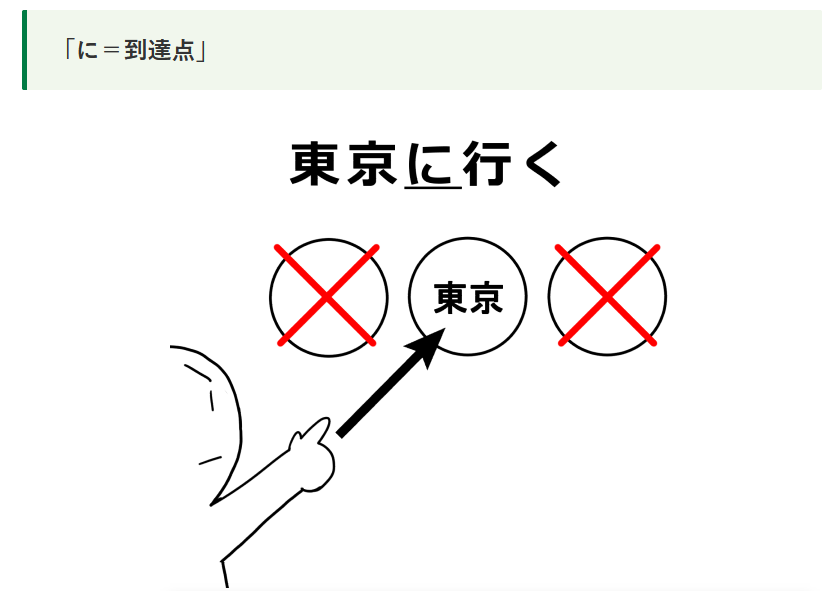

But otherwise, yeah, I agree with ポールおじちゃん.
I tried to search for some specific nuances or confusion that native Japanese may have but I couldn't find anything besides that one.
に is about 目的地(もくてきち), 到達点 (到達(とうたつ) + 点(てん) -> arrival/reaching point) or 到着点 (到着(とうちゃく) + 点(てん) -> arrival/reaching point)
And へ is about 移動の方向 or just 方向(ほうこう) (so direction or direction of mouvement)
I guess the difference is a bit like "I'm heading towards home" vs "I'm going home". And you wouldn't say the former most of the time.
If it's not that, I'm really curious about it because I have no other idea.
Just found a fun image about that while reading some japanese articles :)
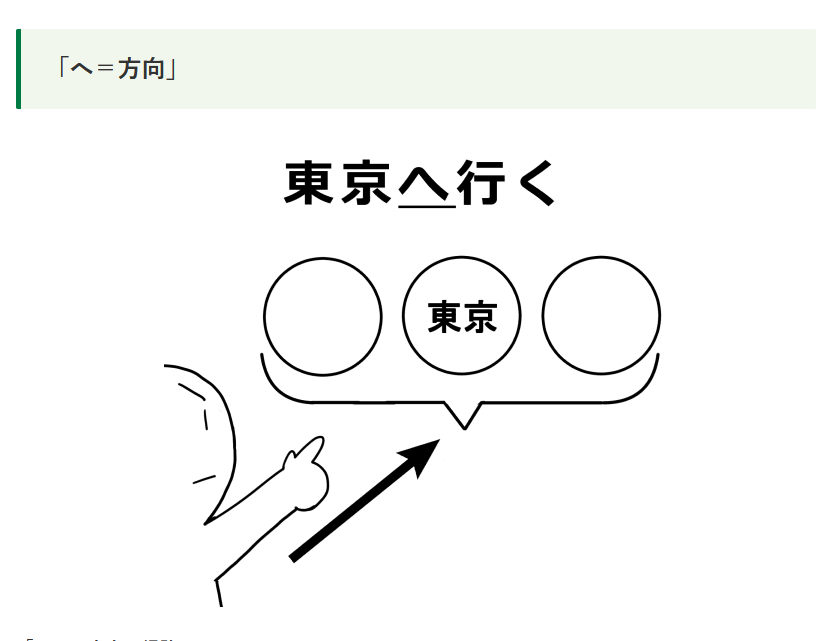

But otherwise, yeah, I agree with ポールおじちゃん.
I tried to search for some specific nuances or confusion that native Japanese may have but I couldn't find anything besides that one.
に is about 目的地(もくてきち), 到達点 (到達(とうたつ) + 点(てん) -> arrival/reaching point) or 到着点 (到着(とうちゃく) + 点(てん) -> arrival/reaching point)
And へ is about 移動の方向 or just 方向(ほうこう) (so direction or direction of mouvement)
I guess the difference is a bit like "I'm heading towards home" vs "I'm going home". And you wouldn't say the former most of the time.
If it's not that, I'm really curious about it because I have no other idea.
There's another way I've been remembering it.
に is like the number 2, ニ. You're arriving TO a particular place. Just that place. Another thought is that if "ni" is flipped into "in", it describes a place that someone is going to be in.
へ, while the pronunciation is actually え since it's a particle, I like to remember the regular pronunciation, he. It's also kind of shaped like an arrow, indicating a direction or HEading to a place, rather than just pinpointing a spot like に does.
So, this indicates their main differences in context. に is for talking about being at a place, へ on the other hand is about taking a journey to a place.
There's another interesting point when へ can be interchangeable with まで, but I would say まで kind of strictly is like に, especially with the to - from comparison used with the から - まで pattern. へ maintains the emotional appeal of a direction. Like if you were talking about a distance between places, まで is about pinpointing the distance of places A to B, but へ adds more elaboration about the distance rather than just plainly saying how far apart they are in the conversation.
Further thoughts: I don't view it necessary to reassure anyone that it would be "grammatically correct" to use one or the other. The issue isn't grammar itself. There's really no question or uncertainty about it. They're grammatically correct as far as grammar is concerned. This is about meaning. Machine translation (which would be a bad example to use anyhow) will still basically translate them the same way. The problem is that it won't show the emotion of the statement.
For example, these simple sentences at the top of my head (since I can barely even think of the words to even write at this point since I'm not a native speaker, but this will do):
「家に行きます。」
「家へ行きます。」
Google Translate is gonna say "going home", but it doesn't elaborate further. A human would add emotion by translating these sentences more accurately. Yes, they're "basically" saying the same thing if you really simplify it to the point of omitting context. That's the big factor here.
A native speaker would use either に or へ as a preference, but one or the other actually affects what they're actually saying. To me, it affects their manner of speaking and what they're actually saying, not just interchanging particles.
There's another way I've been remembering it.
に is like the number 2, ニ. You're arriving TO a particular place. Just that place. Another thought is that if "ni" is flipped into "in", it describes a place that someone is going to be in.
へ, while the pronunciation is actually え since it's a particle, I like to remember the regular pronunciation, he. It's also kind of shaped like an arrow, indicating a direction or HEading to a place, rather than just pinpointing a spot like に does.
So, this indicates their main differences in context. に is for talking about being at a place, へ on the other hand is about taking a journey to a place.
There's another interesting point when へ can be interchangeable with まで, but I would say まで kind of strictly is like に, especially with the to - from comparison used with the から - まで pattern. へ maintains the emotional appeal of a direction. Like if you were talking about a distance between places, まで is about pinpointing the distance of places A to B, but へ adds more elaboration about the distance rather than just plainly saying how far apart they are in the conversation.
Further thoughts: I don't view it necessary to reassure anyone that it would be "grammatically correct" to use one or the other. The issue isn't grammar itself. There's really no question or uncertainty about it. They're grammatically correct as far as grammar is concerned. This is about meaning. Machine translation (which would be a bad example to use anyhow) will still basically translate them the same way. The problem is that it won't show the emotion of the statement.
For example, these simple sentences at the top of my head (since I can barely even think of the words to even write at this point since I'm not a native speaker, but this will do):
「家に行きます。」
「家へ行きます。」
Google Translate is gonna say "going home", but it doesn't elaborate further. A human would add emotion by translating these sentences more accurately. Yes, they're "basically" saying the same thing if you really simplify it to the point of omitting context. That's the big factor here.
A native speaker would use either に or へ as a preference, but one or the other actually affects what they're actually saying. To me, it affects their manner of speaking and what they're actually saying, not just interchanging particles.
Those are really nice mnemonic for those who use them :3 (I don't really use mnemonic in my case, it's a good method and I know it works but I can't xD)
As for the last part, yeah, I agree. But I don't have any proof or solid explanation. I had a few idea in mind but just after some quick research, I am already not sure anymore. I think I will ask to some Japanese natives too but I don't think they will have any satisfying answers. So, maybe in a few years, I will have an answer (if I become 上手 x) ). Or if I'm lucky and met a native that is good at writing/like words or obscure nuances. Because each time, I asking that kind of question to a native, I only have a "えぇ、そうなんだ!" as an answer 
It's too bordeline intuitive level AND I ended up misunderstanding things too until a more knowlegeable native corrected me (when I was lucky enough to met one).
So yeah... I agree but I don't know what to say 
Yeah, it won't be intuitive enough until you learn how it works and how this affects the context. You'd have to be analytical about that part of speech until you can understand its nuance. That's just a part of learning Japanese, I guess.
One thing I've done is that with the schedules here, I do try to keep them as small as possible, but also to cover comparisons like this. So, combining に and へ particles, for example, I can practice filling in the blanks and keep up with remembering how to use it.
I do the same type of thing with contrasting います vs あります sentences, for example. Not just to match the sentence, but to ensure that it makes sense. I wouldn't want to mix up animate things with あります, or vice versa with inanimate objects to います. They're the opposite, so my only mnemonic for that is that います belongs to animate things, あります for inanimate ones. I and A, but reverse. Pretty simple!
This is yet another example that you have two words that can have the same basic meaning, but their use is for particular things. It isn't always that meaningful in translation, but it matters in Japanese.
Yep, funnily enough, textbook do a good job for those kind of things compared to app. I never managed to learn with textbooks but sometime, I do wish to practice more in a "textbook way". But oh well, I found my way too somehow :3
Only thing needed now is patience and perseverance (kinda running out of those two right now but they will probably come back at some point x) ) .