掲示板 Forums - Where to find a list of casual terms?
Top > 日本語を勉強しましょう / Let's study Japanese! > Anything About Japanese Getting the posts
Top > 日本語を勉強しましょう / Let's study Japanese! > Anything About Japanese
I'm trying to find a list of casual verb endings and sentence endings, maybe common contractions too if there are any, that also shows what regular-form terms they correspond to. Does that exist, either on renshuu or somewhere else?
I wanted to create a few list about that but... I was overly ambitious so, it's on hold for now until I can restructure it.
The problem with casual conversation is that it depends on the whole sentence rather the individual words. It also depends who you're speaking with too.
For example:
"そうっすね" is the abbreviated version of "そうですね" ("I see"). っす is often described as semi-casual but in pratice, it's really depends on the other person. Some will say "Stop talking like a brat" because it has some "bratty vibes". Other people will say "Why are you still speaking so politely?" x).
So that kind of list is quite difficult to find. You can still find a few article here and there, but I never saw a ressource that gave a good overall picture. Which is understable when you understand what is a casual conversation. It's hard to explain everything in a single article or list but at the same time, you need that complete picture. For example:
これを知っていますか? vs 知ってる? (Do you know about that?)
There are already a lot of thing here.
In full casual mode, you will often drop everything (particule, subject, etc). Hence why the "これを" and the か disapear.
You also drop the ます and you often contract the いる to る (知っている -> 知ってる).
It's all of those things that make the sentence casual, not the individual part.
Casual conversation also feel casual in comparison to polite conversation. What I mean by that is, for example, that casual sentence are shorter than polite one. And it kinda gives the impression that you're not making any effort to construct your sentences (in comparison to polite speech). You kinda to know both side to really understand casual speech.
Because the intermediate, in between casual/polite speech is where the nighmare begin x)
知ってます?
Still polite? Or casual?
Well, with an older person, it's a casual conversation probably. With someone from the same age, could be casual, could be polite. With someone younger than you, it's probably too polite.
Anyway, just a warning about that aspect. And also an explanation as to why you may struggle to find a good ressource about that. In my case, I had to learn it the hard way by watching youtube and talking to japanese friends online (since I couldn't find any good ressources). I will just list a few things that I can remember from the top of my head:
- いる abbreviated into る is more casual
- です abbreviated into っす is more casual
- わからない abbreviated into わかんない is more casual
- 食う (くう) is the more casual version of 食べる (たべる)
- You often drop a lot of words in casual speech (particule, subject, object, verb, etc)
- The word order is often mix for various effect (これは美味しい -> おいしい、これ)
- ぞ、ぜ are more common in casual speech but it's not really they are "casual", it's because they give a "rough" feeling
And I think, that's all I'm able to remember from the top of head. Do note that I said "more casual" for each of them tho (for the previous reasons I was talking about).
Also, If you want to take your studies of casual speech to the next level, I recommend creating a custom list of sentences. There are quite a lot of casual sentence on renshuu (more than I thought). I don't know if you saw the new "study group" feature but I created a group for that purpose if you're interested (Community builder list). If you go there, we could help you to create your own custom list. But at the same time, just searching for those expression and studying them in a sentence schedule could already be good enough for now :)
Anyway, good luck for that and hope that help a bit,
頑張ってね~
AFAIK, the plain dictionary form is basically casual in itself. There are cases you have a casual modification to add to it as well, and for everything else there's some others which add more politeness to a certain degree.
If you practice conjugating verbs, adjectives, etc., with casual speech schedules, you can familiarize yourself with casual forms of words, vs ones that are polite. That's how you can tell.
There's also a feature for verbs, for example, that when you learn about the casual past form, it follows mainly the same pattern as the て form. Pretty neat, right?
A custom list of sentences? I guess I've seen that as an option, but I don't really know how it works
Do you add sentences from renshuu somewhere or have to write them? Can it be scheduled for study? Is it like reversed grammar quizzes if so?
Waah, renshuu really has too many unused features x) (It almost needs a 6 month tutorial to find your best way to study
)
Honnestly, it's one of my favorite tool and it's also quite simple.
On PC and the app, you go just to Resources (top left on PC and you need to click on the menu icon on the app first, then ressources) and then Community Lists.
Then you will arrive on that page
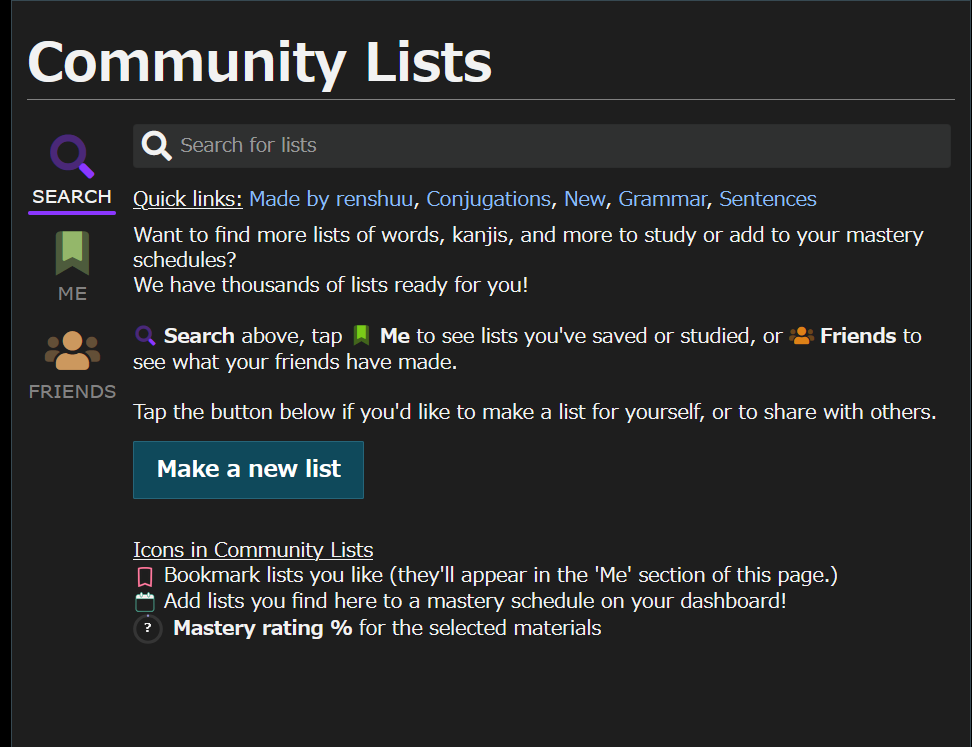
You just need to click on "Make a new list", select what type of list you want (words, kanji, grammar, sentences)
And you will arrive here
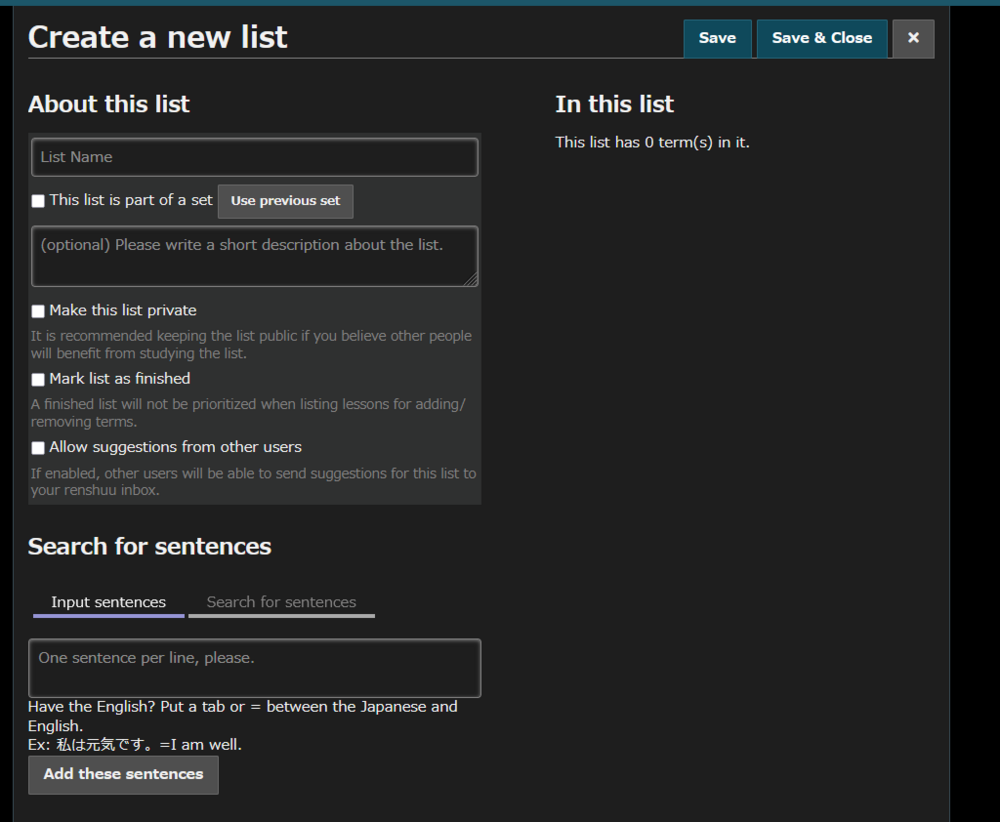
Once there, you need to at least named your list and add at least one sentence.
The Input sentences box is for when you need to add a custom sentences.
If renshuu doesn't find it in its database, you will end up with that and you will have the possibility to add the sentences with a translation.
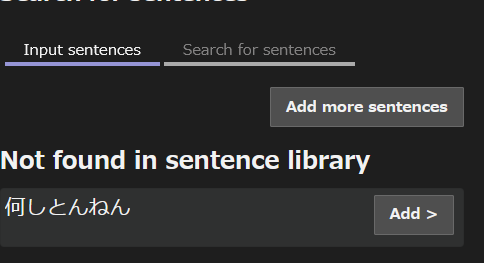
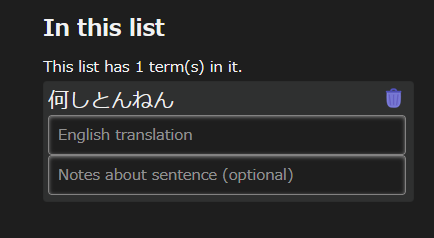
The search for sentences box on the other hand allow you to browse renshuu database for words, sentences, kanji, grammar. Like this
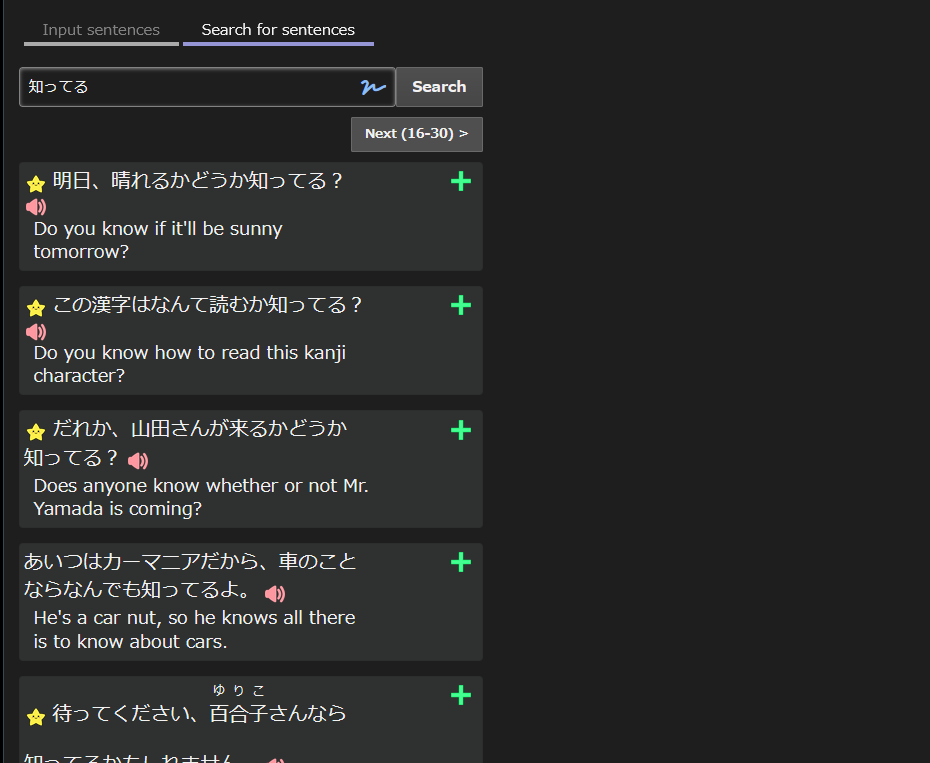
You can search by words or even complete sentences. Once you've added at least one sentence and saved the list, you can also add new sentences from anywhere. Like from the Sentences Lookup features (you just need to click on the green cross)
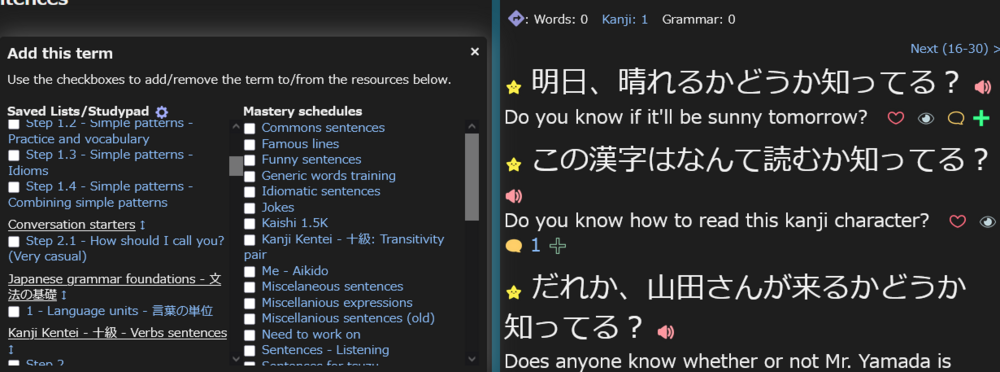
Same when you're studying a word schedule, you can often click to see sentences related to that words and next to them, that green cross.
And after that, you can schedule any list, from the community list section, under me. It's the calendar icon

And now, you can study your list like any schedule =p.
Thanks to マイコー, we can also work together on the same list! (there is an "allow suggestions from others)
Making the process far more easier than before! So yeah, go for it 
As for how to study sentences, I recommend the basic question vector. It just asks you if your understand the sentences or not (the other setting take too much time and when it come to studying sentences, quantity is more important imo). And you can be more or less strict toward yourself too. For example, I only say yes, when I understand everything and can read everything. But it's up to you for how you want to do that =p
If you have any other questions don't hesitate to ask =p
You asking something quite difficult to answer x)
I recommend creating your own post and developing a bit. Like how you're currently studying, what is difficult for you, etc.
We will able to help more like that!